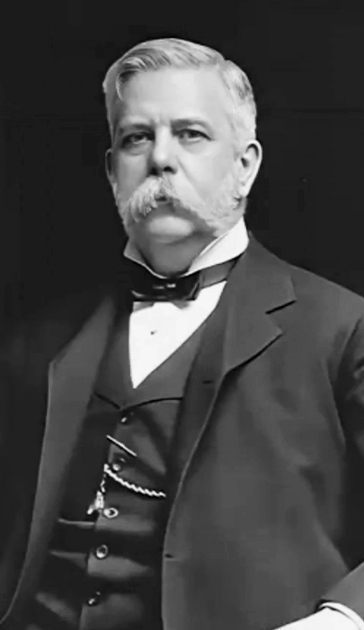
An engineer, inventor, and industrialist, George Westinghouse Jr. (1846–1914) played a major role in the development of electrical power systems, and he revolutionized railroad safety through the invention of an air brake system used worldwide.
Born and raised in New York, Westinghouse showed an early talent for mechanics and innovation. In 1868 he moved to Pittsburgh and founded Westinghouse Air Brake Company in the city’s Strip District. He later relocated those operations 12 miles southeast to Wilmerding.
During his career, Westinghouse received 360 patents and formed 60 companies—most based in the Pittsburgh region—ranging in focus from railway track-switching and signaling to the production and use of natural gas. Through his Westinghouse Electric Company, which still operates today and is headquartered in Cranberry Township, Pa., he became famous for promoting alternating current (AC) electricity as safer and more efficient than direct current (DC). His work enabled electricity to be transmitted over long distances, in essence electrifying the world. He was also a pioneer in providing educational and cultural opportunities for his employees and limiting work hours.
For more than 40 years, Westinghouse lived in Pittsburgh’s Point Breeze neighborhood, where he built a mansion and a private laboratory. In 1919, the structures were torn down and the property became a city park. Today, Westinghouse Park—and the lights that illuminate it at night—are examples of the countless ways Westinghouse’s legacy lives on.